Frank Carter–Julian Simpson–Dominic Barnett exploitation network
The Whisper ManThe Frank Carter–Julian Simpson–Dominic Barnett exploitation network is the concealed afterlife of Frank Carter’s murder of Tony Smith. It joined Carter’s criminal knowledge to the property on Garholt Street, where Tony’s remains were hidden, transferred, and eventually displayed to paying visitors. The network matters because it separates the arrest of a killer from the recovery of a victim: Tony remained missing for twenty years, while his death continued to generate secrecy, money, curiosity, and further violence.
Formation and Hidden Geography
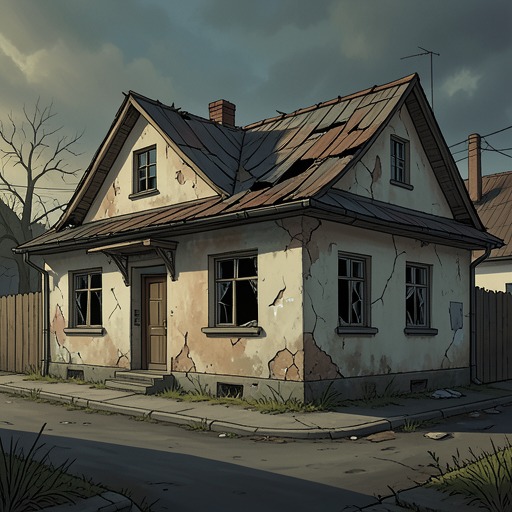
The network began with the relationship between Frank Carter and the house on Garholt Street. After Carter killed Tony, forensic evidence showed that the boy had been held in Carter’s van, but Carter never disclosed where he had left the body. The house was on a natural route between the place where Tony had been abducted and the direction in which Carter fled. That geography created a plausible opportunity for Carter to abandon the body there if he had learned that his own house was being searched. Julian Simpson was renting the property at the time, yet his name had not appeared among Carter’s known acquaintances during the original investigation.
The property had a history that allowed the concealment to persist. Anne Shearing had inherited the house from her parents but had not lived there for decades, renting it to a succession of occupants. Simpson had rented it for four years before 1997 and remained there until 2008. After his death from cancer at the age of seventy, Dominic Barnett became the tenant and stayed until the year in which the remains were found. The succession of tenants gave the house continuity without making the underlying connection visible: one man appears to have received or stored the remains, and another later inherited control of the place where they were kept.
Concealment, Transfer, and Exhibition
The network’s operating structure became clear through Norman Collins’s account. Collins said that he was first directed to Victor Tyler through an arrangement connected with Carter. Tyler vetted prospective visitors, and money was delivered to Tyler’s wife before Collins was sent to an address. Collins was then directed to Julian Simpson. This arrangement made Tyler and Simpson intermediaries between Carter’s imprisoned reputation and the hidden remains, while keeping Carter himself away from direct involvement.
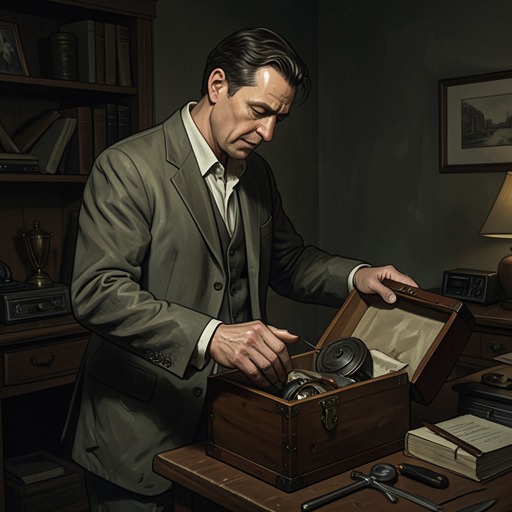
At Simpson’s house, Collins paid additional money and waited in a downstairs room. Simpson eventually returned with a sealed cardboard box, opened it carefully, and revealed Tony Smith’s remains. Collins identified the body as Tony Smith. The box was therefore not merely a container but part of the network’s mechanism: it preserved the remains, concealed their existence, and enabled their movement into a private economy of access.
The arrangement continued after Simpson’s death, when Dominic Barnett took over. Collins believed Simpson and Barnett had been friends, but described a deterioration in the conditions under Barnett’s control. Barnett allowed people to visit the exhibit, and Collins said that five or six other visitors were present on his final visit. They had been drawn by the case, some apparently travelling a considerable distance, and they began touching the bones. Collins regarded this as an intolerable violation of the remains, while Barnett laughed and showed no concern. The hidden body had become a spectacle whose visitors treated a murdered child as an object of fascination.
Money, Responsibility, and Violence
Payment moved through the network, although it did not reach every participant. Tyler, or Tyler’s wife, was paid; Simpson was paid; Barnett was paid. Carter denied caring about money for himself, presenting his imprisoned life as one in which everything he wanted was already free. He nevertheless defended the payments to Tyler and Simpson as compensation for what they had done for him, and insisted that visitors ought to pay for access to the place and to the remains. His response reveals a system in which the victim’s body became valuable because it was connected to Carter’s notoriety.
The financial arrangement also exposed different forms of complicity. Carter supplied the crime and the reputation that made the remains desirable. Tyler controlled access from prison and selected the people who approached him. Simpson concealed Tony and managed the first known exhibition of the remains. Barnett later controlled the house and continued the exhibition, but his treatment of the bones provoked Collins’s disgust. The network was therefore not a simple partnership with a single motive; it combined concealment, loyalty, payment, curiosity, and control over access.
Barnett’s refusal to allow Collins to return, and his refusal to refund him, helped produce the network’s later violence. Collins said that he killed Dominic Barnett because Barnett would no longer grant him access and because he believed he had to protect the exhibit and keep Tony safe. The claim is morally distorted: Collins’s stated concern for Tony’s dignity coexisted with his earlier payment to view the remains. Yet the conflict shows how possession of the body had become a source of authority and violence. Control over Tony’s remains was treated as a private right, and the struggle to retain that right ended in Barnett’s murder.
Discovery and Belated Identification
The network was finally exposed when a second body was reported at a house on Garholt Street. The remains were much older than the first body discovered in the investigation and appeared to have been hidden for a long time. A forensic examination identified them as the remains of a male child who had been about six years old at death. The remains had been dead for some time, possibly twenty years, and the cause of death might never be established.
The scene offered fragments rather than a complete story. The bones had been laid out in the shape of a small child, but age had separated many of them and no flesh remained. Clothes had been recovered beneath the bones, and the remains had been brought to the mortuary in the box to help preserve them. The material evidence could establish age, sex, duration of death, and the history of concealment more readily than it could reconstruct the precise manner of killing. That limitation kept the investigation anchored in the distinction between what could be proved and what remained unknowable.
The identification of Tony Smith changed the meaning of the old disappearance. His parents, Miranda Smith and Alan Smith, had sat exhausted in a reception area when their son first went missing, and twenty years later he still had not been found. Carter had been arrested after roughly a day and a half on the run, nearly a hundred miles from Featherbank, and had admitted killing Tony while refusing to reveal where he had discarded the body. Tony’s remains therefore restored a name and a physical truth to a case that imprisonment alone had left unresolved.
Consequences and Significance
The network demonstrates that Frank Carter’s crime did not end with his arrest or life imprisonment. The hidden body remained available for concealment, exchange, viewing, and exploitation. Julian Simpson’s long tenancy, Dominic Barnett’s later control, Victor Tyler’s prison-based intermediary role, Collins’s visits, and the visitors’ fascination extended the harm across decades and converted private grief into a morbid public commodity.
The discovery also altered the investigative understanding of Carter’s circle. The investigators had to connect the route of the original abduction, the house’s tenancy history, the box, the remains, and Collins’s account. They also confronted the contrast between this burial site and Carter’s known methods: the newly discovered child had been killed elsewhere and moved, whereas Carter had killed earlier children where they were found and kept them in his house. The difference did not remove Carter from the chain; it showed that his crimes could produce different forms of concealment and that the network surrounding him had developed its own practices.
Most importantly, the network clarifies why finding Tony mattered beyond solving a historical puzzle. Pete Willis’s governing belief was that everyone should be able to go home. Tony could not return alive, but identifying his remains ended the most absolute form of uncertainty surrounding his family. At the same time, the scene in which the bones were handled and exhibited shows how recovery can be accompanied by a second violation. The network’s eventual exposure provided truth and the possibility of dignified return, but it could not undo the years in which Tony was hidden, bought, displayed, and fought over as an object.